Bandim Health Project:
A health and demographic surveillance system site situated in Guinea-Bissau, West Africa
Bandim Health Project
Bandim Health Project follows a population of more than 200,000 individuals in urban and rural Guinea-Bissau. This provides a unique platform for conducting health research. One of the major research areas is to study the “real life” effects of vaccines, vitamin A and other health interventions to women and children. Other research areas include malaria, tuberculosis and HIV/AIDS.
Bandim Health Project is a collaboration between the Guinean Ministry of Health and University of Southern Denmark. Formally, it is placed under the Guinean National Institute of Public Health. The main offices are placed in the suburb Bandim. The Danish part of the group group is hosted at the Danish National Institute of Public Health, University of Southern Denmark.
DIAS researchers visit the Bandim Health Project in Guinea-Bissau
A team of nine researchers from five faculties at the University of Southern Denmark, have been on an excursion to Guinea-Bissau to collaborate with the Bandim Health Project. To explore the potential of interdisciplinary approaches in tackling complex problems, each researcher brought unique perspectives and areas of expertise to the table.
During the eight-day trip, the research team visited several Guinean institutions, including the Instituto da Biodiversidade e das Áreas Protegidas (IBAP), the United Nations Development Program (UNDP), the national hospital, and INEP, the Guinean Social Science University. These experiences provided ample food for thought, emphasizing the value of interdisciplinary viewpoints when addressing challenges. The aim of the fieldtrip, was to foster groundbreaking ideas and solutions through curiosity-driven research, transcending disciplinary boundaries.
Funding for this trip to Guinea-Bissau was provided by the Danish Institute for Advanced Study (DIAS).
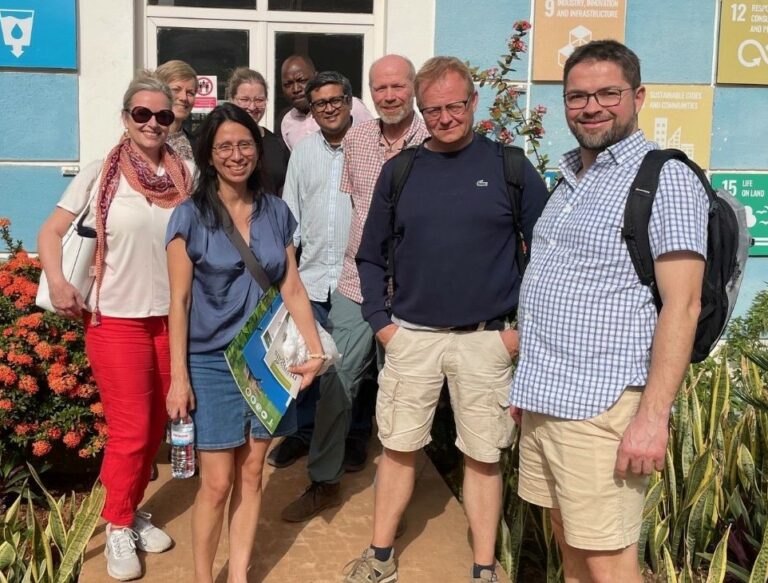
Participants: Sune Vork Steffensen, Sebastian Mernild, Søren Tollestrup Askegaard, Shriram Venkatraman, Cintia Organo Quintana, Maria Elo, Elzbieta Pastucha, Sani Abdullahi, Christine Stabell Benn, Peter Aaby & Ane Fisker
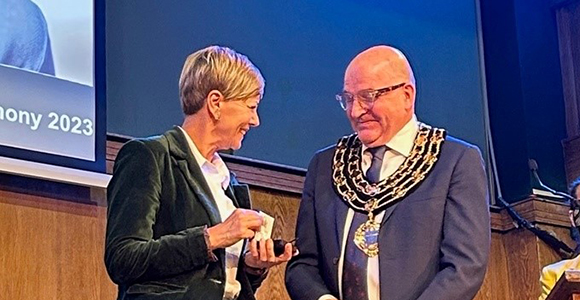
Professor Christine Stabell Benn has been awarded the George Macdonald Medal
The medal is awarded by The Royal Society of Tropical Medicine and Hygiene and the London School of Hygiene & Tropical Medicine, for outstanding research leading to improvement of health in the tropics.
OPTIMMUNIZE 2022
In November 2022 OPTIMMUNIZE organized a conference in Odense with the topic: Optimizing the beneficial non-specific effects (NSEs) of vaccines.
WE ARE PROUD
Non-specific effects of vaccines named a vaccine milestone by Nature
The world-leading scientific journal “Nature” has made a list of the major milestones in vaccines. The discovery of the beneficial non-specific effects of live attenuated vaccines made by Peter Aaby in 1984 was one of them (milestone 13).
Bandim books
Bandim Health Project have published three books in the last 40 years with “Forty years of contradicting conventional wisdom 1978 – 2018” being the latest.
How vaccines train the immune system in ways no one expected | Christine Stabell Benn | TEDxAarhus
VACCINE CURIOUS
Christine Stabell Benn
This podcast investigates vaccines and does so with curiosity.
Whether it be from a medical or a personal angle each guest offers different perspectives on what we know about vaccines.
Your host is professor in global health from University of Southern Denmark, Christine Stabell Benn.
//
Coronapandemien har stillet skarpt på, hvad vi ved om vacciner, og hvad en nål i skulderen betyder for den enkelte, for samfundet og for forskningen.
Denne podcast undersøger vacciner og gør det med nysgerrighed.
Uanset om det er fra en medicinsk eller en personlig vinkel, tilbyder hver gæst forskellige perspektiver på, hvad vi ved om vacciner.
Din vært er professor i global sundhed fra Syddansk Universitet, Christine Stabell Benn
NONSEnse
A NordForsk-funded consortium to study childhood morbidity and potential non-specific effects of the childhood vaccination programs in the Nordic countries